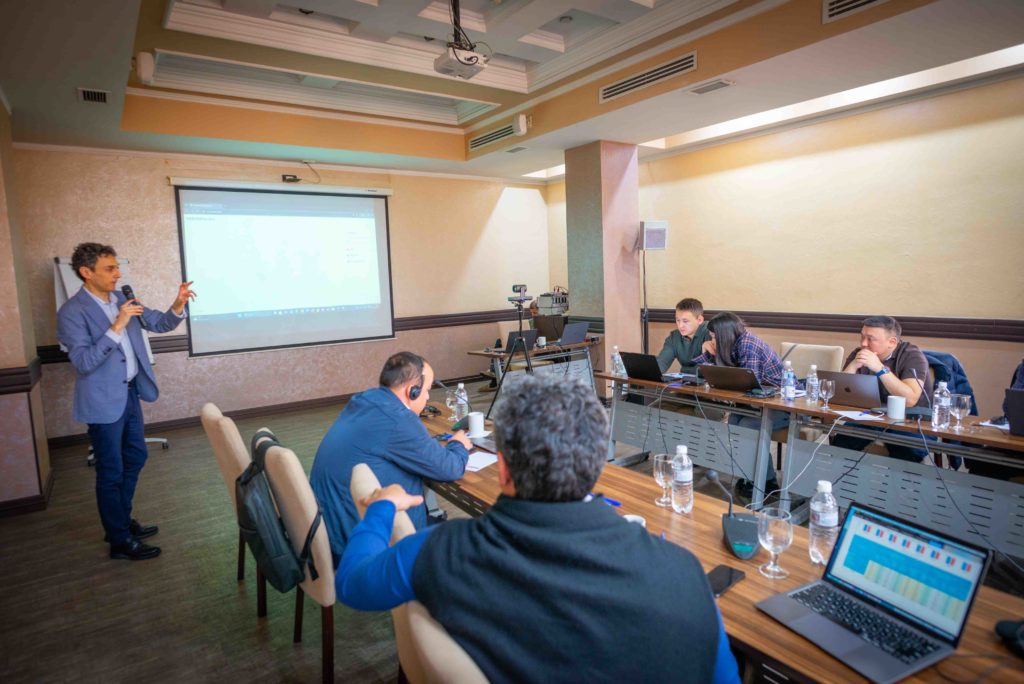


Bishkek, Kyrgyzstan – On 5 December 2025, SECCA project experts held a series of technical meetings with representatives of relevant organisations in the Kyrgyz Republic on the topic: “Improving the Energy Efficiency of Public Buildings: Approaches and Recommendations. Implementation of ISO 50001 at the National Level in Kazakhstan”.
During the meetings, SECCA national coordinator in Kazakhstan Zhaxylyk Tokayev presented a new approach being developed within the project for working with data on public buildings. The core idea of this approach is the following: the SECCA project, together with the Electric Power and Energy Saving Development Institute of Kazakhstan, conducted an analysis of the current state of data management in the public building sector and proposed a comprehensive 10-step methodology aimed at more effective use of the State Energy Register and the subsequent in-depth analysis of priority facilities from an energy-efficiency standpoint.
One of the key components of this methodology is a system for prioritiыing entities listed in the State Energy Register that are public institutions, enabling their phased selection for in-depth monitoring and on-site energy audits.
The proposal essentially establishes a systematic selection mechanism that takes into account both the large volume of data and the high number of facilities. At present, more than 24,000 public and quasi-public sector entities are registered in Kazakhstan, making it practically impossible to conduct energy audits for all facilities at once. In this context, the developed methodology uses a set of seven indicators that can be digitised and used to rank facilities by priority. In addition, a verification questionnaire has been created to minimise risks associated with human error during data entry and to ensure a more complete and accurate picture of each facility.
The purpose of presenting this approach was to share experience, demonstrate SECCA’s practical work, and help promote a more structured and systematic way of working with the public sector.
It is important to note that in all five beneficiary countries of the project, social and public buildings are fully funded by the state budget, making energy efficiency measures in this sector strategically important.