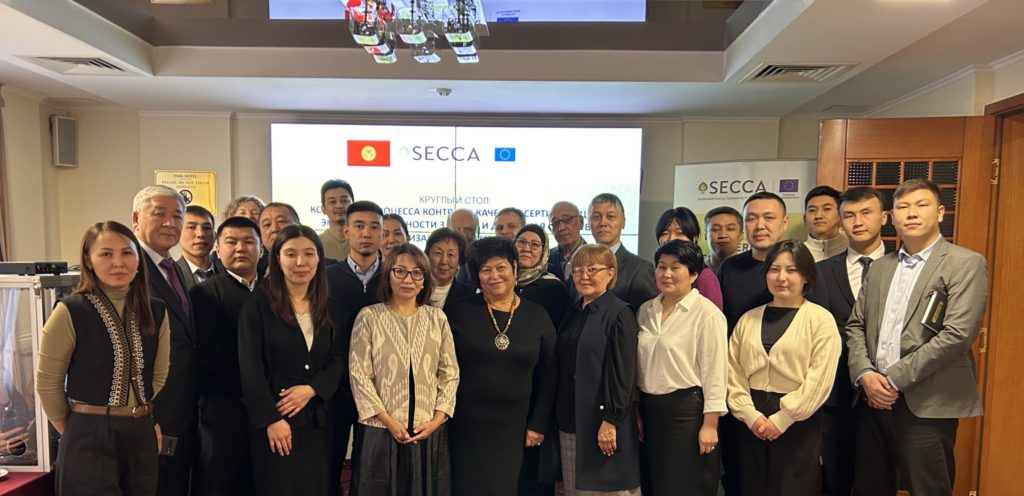

Astana, Kazakhstan – The European Union-funded project “Sustainable Energy Connectivity in Central Asia (SECCA)” held a Closing Roundtable in Astana on 7 April 2026. The event gathered representatives of the Ministry of Energy of the Republic of Kazakhstan, Ministry of Industry and Construction of the Republic of Kazakhstan, Bureau of National Statistics of the Agency for Strategic Planning and Reforms of the Republic of Kazakhstan, Institute for the Development of Electric Power Industry and Energy Saving, the European Union (EU), the EU projects, and ECOJER Association.
Opening the Roundtable, Dr Johannes Baur, Head of Cooperation at the EU Delegation to Kazakhstan, said: “The European Union and Kazakhstan have built a strong partnership over the years. Sustainable energy is an important part of this cooperation. We share the objective of a cleaner, more secure, and more efficient energy system. SECCA has contributed to this effort. It has supported policy development, strengthened institutions, and promoted practical solutions in renewable energy and energy efficiency. It has also helped connect public authorities, experts, academia, and the private sector.”
Ms Baltugan Tazhmakina, Deputy Director of the Department of Renewable Energy Development at Ministry of Energy, in her opening speech expressed gratitude for the project’s contribution to green energy transition of Kazakhstan, and presented a “Letter of Appreciation” signed by the Minister of Energy of the Republic of Kazakhstan to the project management.
SECCA experts Mr Paata Janelidze, Ms Ilze Purina, and Mr Zhaxylyk Tokayev then delivered a presentation on the project work in Kazakhstan, outlining main approaches, activities, and results. During its four-year implementation period, the project has provided a targeted policy advice, capacity-building and analytical support to Kazakhstan, thus contributing to strengthened regulatory framework, informed energy planning, improved decision-making for energy efficiency and renewable energy deployment.
Working closely with national partners, SECCA enhanced capacities of national energy professionals in energy statistics, energy audit, energy labelling, and other. The project conducted an assessment of biomass potential, developed recommendations for the development of the system of presuming, small hydropower, and geothermal energy production. Furthermore, the SECCA experts consulted on reduction of methane emissions, providing an analysis of past and future emissions scenarios, and the impact of EU methane regulations on export from Kazakhstan.
The SECCA presentation also highlighted the work dedicated to enhancing capacities of universities and research institutions for effective participation in the EU’s Horizon Europe programme. Last but not least, the experts reported on the activities aimed at raising awareness among the general public, including women, youth, and children, about importance and benefits of sustainable energy, and its interlinkage with climate. This work was conducted primarily within the framework of the EU–Kazakhstan Sustainable Energy Days campaigns, as well as through a SECCA-produced podcast “Energiya Joly”.
Following that, Ms Bettina Loewentraut-Duran, Deputy Programme Manager of the regional project “EU4SustainableCentral Asia: Renewable Energy in Central Asia (EURECA)”, spoke of this project’s current activities in Kazakhstan and Central Asia.
The participants then discussed future opportunities for cooperation, with both the EU and Kazakhstan reaffirming their commitment to continued cooperation for sustainable development and green energy transition of Kazakhstan.