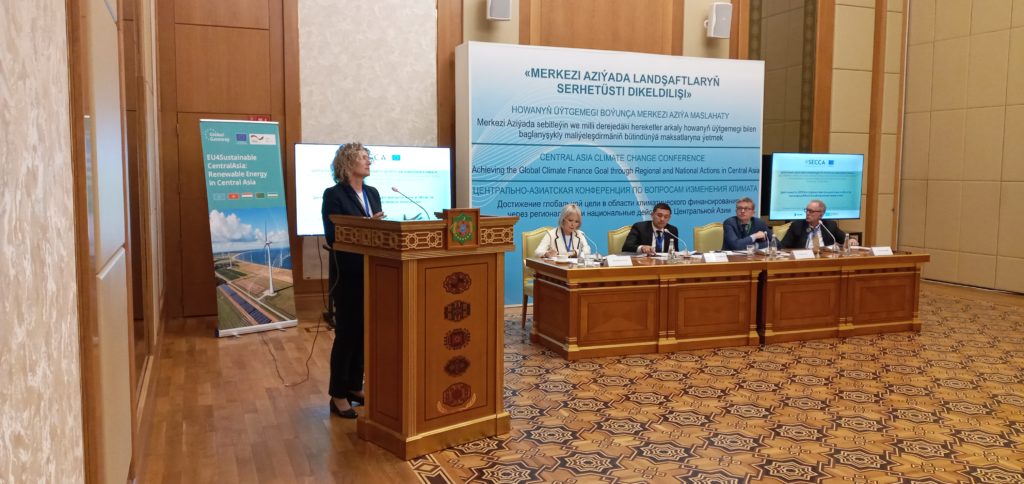

Ashgabat, Turkmenistan – On 29 April 2026, the European Union-funded SECCA project held a Closing Roundtable in Ashgabat and presented its key achievements and lessons learned from project implementation in Turkmenistan. The event brought together key national partners, including representatives of the Ministry of Energy of Turkmenistan, the Ministry of Education of Turkmenistan, their affiliated institutions, specialists of the State Electric Power Corporation “Turkmenenergo”, as well as faculty members and students from universities, representatives of the EU Delegation to Turkmenistan, and experts from the UNDP project “Developing National Capacity of Turkmenistan through Improving Regulatory Environment towards Energy Efficient and Sustainable Building Sector (TEESB)” and the EU project “EU4SustainableCentralAsia: Renewable Energy in Central Asia (EURECA)”.
The discussion was formally opened by Amanmyrat Arazov, Head of the Academic Department at the Turkmen State Institute of Architecture and Construction, Vepaly Berdiyev, Head of the Department for Development of Legal and Technical Normative Documents of the Ministry of Energy of Turkmenistan, and Borislav Dimitrov, Programme Manager of the EU Delegation to Turkmenistan.
Key project experts Paata Janelidze and Ilze Purina, along with National Coordinator Atamuhamet Sariyev, then presented the outcomes of SECCA’s work in Turkmenistan. These included progress in developing and improving policy and regulatory frameworks, energy modelling, integrated energy and climate planning, promoting green and sustainable construction, facilitating investment in renewable energy, strengthening EU–Turkmenistan cooperation on sustainable energy and the green transition, and advancing scientific collaboration under the EU’s Horizon Europe programme. The experts also reported on awareness-raising activities carried out as part of the annual campaign “EU–Turkmenistan Sustainable Energy Days”, which targeted the general public – including women, youth, and children – on sustainable energy, its benefits, and its interlinkage with climate. It is noteworthy that this campaign took place in Ashgabat, Mary, and Turkmenbashi between 2023 and 2025.
Following the presentation, roundtable participants discussed indicative plans for future cooperation. Turkmenistan and the EU reaffirmed their commitment to continuing joint efforts toward Turkmenistan’s sustainable development and clean energy transition, in line with the country’s national priorities.
This roundtable concluded the SECCA project’s final mission to Turkmenistan, which took place from 22 to 29 April 2026. Earlier, the project, together with TEESB, organised a series of training workshops on sustainable energy.